Singles
A single is a bet on one selection. If it wins you get your stake back along with your winnings, and if it loses the stake is gone. These are the single bet types you will come across most often at the best betting sites.
Win Bets
A win bet backs one result in one event, which makes it the simplest bet available.
Example: Liverpool are 6/4 to win away at Newcastle, which is 2.50 in decimal odds. A £10 stake returns £25 in total if Liverpool win, made up of £15 in winnings plus your £10 stake back. A draw or a Newcastle win loses the bet.
Use it when you have a clear view on one result and want nothing else to affect the bet.
Over/Under (Totals)
An over/under bet is on a quantity rather than a result. Goals are the most common market, but you can also bet on the total number of corners, cards, points or tennis games. The line is almost always set at a half number so the bet cannot finish level.
Example: Chelsea against Aston Villa in the Premier League, over 2.5 goals at 4/5, or 1.80 in decimal odds. A £10 stake returns £18 if three or more goals are scored. A 2-1 finish wins the bet and a 1-1 loses it.
Use it when you have a view on how open a game will be but not on the winner.
Handicaps and Asian Handicaps
A handicap gives one side a head start or a deficit before the event begins, which brings the odds on a strong favourite closer to even money. The favourite carries a minus figure it has to overcome, and the outsider carries a plus figure it gets to keep.
Example: Arsenal are -1.5 on the handicap at home to Everton at 5/6, or 1.83 in decimal odds. Arsenal have to win by two clear goals for the bet to win, so a 2-0 wins and a 1-0 loses. Backing Everton at +1.5 instead wins if Everton win, draw, or lose by a single goal.
An Asian handicap follows the same principle, but the line can be split across two figures, which means part of your stake can be returned rather than lost. A split handicap of -0.5 and -1 puts half the stake on each line and leaves three outcomes.
Use one when a side is a heavy favourite and the straight odds are too short.
Each Way
An each way bet is two bets of the same size in one: one on your selection to win, and one on it to finish in one of the places the bookmaker pays out on. A £10 each way bet therefore costs £20. It is most common in horse racing, where the place part pays a fraction of the win odds, usually a quarter or a fifth.
Example: You back a horse at 8/1 each way with £10, a £20 total stake. The place terms are a quarter of the odds for the first three home, so the place part pays 2/1.
Use it when you like a selection at longer odds but are not confident it will win outright.
Multiples
A multiple combines two or more selections into a single bet. The odds of each selection are multiplied together, which lifts the potential return but also means every leg has to win. One losing leg loses the whole bet.
Doubles and Trebles
A double has two selections, a treble has three, and in both cases every selection has to win.
Example: Two selections at 6/4 (2.50) and 4/5 (1.80) make a double. Multiply the decimal odds together, 2.50 x 1.80 = 4.50, so a £10 double returns £45 if both win. Add a third selection at Evens (2.00) and it becomes a treble: 2.50 x 1.80 x 2.00 = 9.00, which returns £90 from the same £10 stake.
Use them when you are confident about a few selections and want a bigger return than backing each separately.
Accumulators
An accumulator is a multiple with four or more selections. It works exactly like a double or a treble, and most bookmakers let you add up to 15 selections to one bet.
Our guide to what an accumulator is covers the format in full, and the accumulator calculator works out the return on your own selections.
Use one when you want to tie several selections together, bearing in mind that each leg you add makes the bet harder to land.
System Bets (Full Cover)
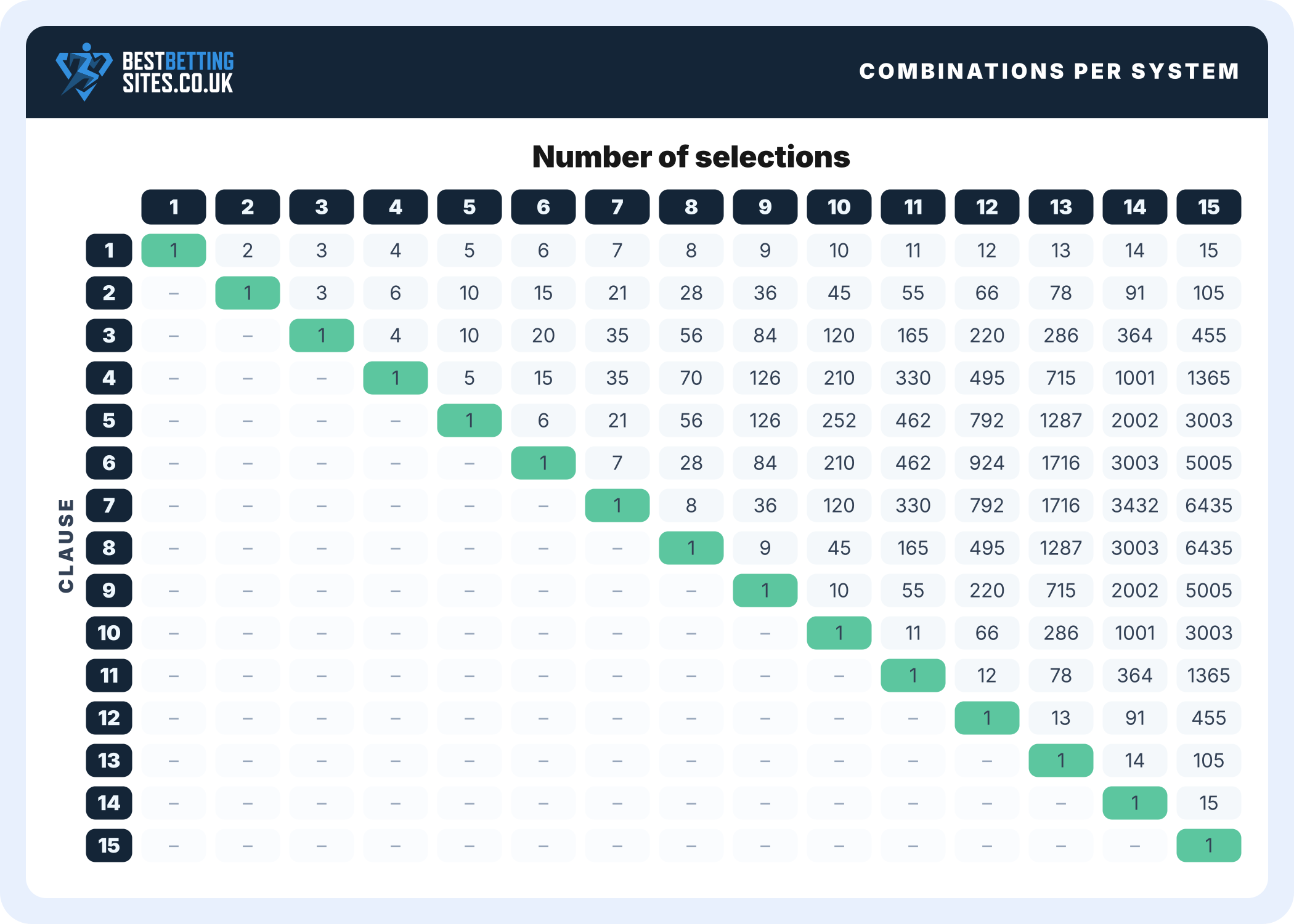
A system bet, also called a full cover bet, covers every possible combination of your selections instead of just the one. Each combination counts as a separate bet with its own stake, so the total outlay is larger, but the bet can still return something when one or more selections lose. Returns are lower than an accumulator on the same selections.
The table below shows the named systems and how their combinations break down.
A Lucky 15 works on the same idea with four selections, adding the four singles to the doubles, trebles and fourfold for 15 bets in total.
The chart below extends the same maths to any number of selections up to 15.
Use a system bet when you want several selections covered and are comfortable with the larger total stake.
Which Bet Type Suits You?
Singles are the sensible place to start, because one selection is easy to follow and easy to price. Multiples multiply the odds, but they multiply what has to go right as well, and a single losing leg takes the whole bet with it. System bets sit between the two, covering more outcomes and still returning something when a selection lets you down, at the cost of a larger total stake. Whichever you choose, set the stake at an amount you are comfortable losing and treat it as entertainment rather than a source of income.